Here are the Latin Mass propers for the traditional feast day of Saints John Fisher and Thomas More (Double of the 1st Class - Red vestments). They are taken from a pre-1955 missal (see citation below). Unfortunately, I was unable to put it in the accent marks with Blogger.
Introit: Ps. xxxiii, 20-21
Multae tribulationes justorum, et de his omnibus liberavit eos Dominus: Dominus custodit omnia ossa eorum: unum ex his non conteretur. Ps. ibid. 2. Benedicam Dominum in omni tempore: semper laus ejus in ore meo.
V. Gloria Patri.
Many are the afflictions of the just; but out of them all will the Lord deliver them. The Lord keepeth all their bones: not one of them shall be broken. Ps. I will bless the Lord at all times: his praise shall be always in my mouth. V. Glory be.
Collect:
Deus, qui beatos Martyres tuos Joannem et Thomam, verae fidei et Romanae Ecclesiae principatus propugnatores, inter Anglos suscitasti; eorum meritis ac precibus concede; et ejusdem fidei professione, unum omnes in Christo efficiamur et simus.
Per Dominum.
O God, who didst raise up Thy blessed martyrs, John and Thomas, from among the English to be defenders of the true faith and of the primacy of the holy Roman Church, grant that through their merits and prayers, we may all become and remain one by the profession of the same faith. Through our Lord.
Epistle: II Machab. vi. 18-28
Gradual: Ps.xxxiii, 6, 16
Accedite ad eum et illuminamini et facies vestrae non confundentur. v. Oculi Domini super justos, et aures ejus in preces eorum.
Alleluia, alleluia. v. Haec est vita aeterna, ut cognoscant te solum Deum verum, et, quem misisti, Jesum Christum. Alleluia.
Come ye to him and be enlightened: and your faces shall not be confounded. V. The eyes of the Lord are upon the just: and his ears unto their prayers.
Alleluia, alleluia. V. This is eternal life: That they may know Thee, the only true God, and Jesus Christ, whom Thou hast sent.
Gospel: John x. 23-28
Offertory: Ps. ixvii. 36
Mirabilis Deus in sanctis suis: Deus Israel, ipse dabit virtutem, et fortitudinem plebi suae: benedictus Deus.
God is wonderful in his saints: the God of Israel is He who will give power and strength to his people: blessed be God.
Secret:
Oblationibus nostris, quaesumus, Domine, placatus intende: ut martyrum tuorum interveniente suffragio, gratiae tuae nobis dona concilient. Per Dominum.
Mercifully regard our offerings, we beseech Thee, O Lord, that through the intercession of Thy martyrs they may obtain us Thy gracious gifts. Through our Lord.
Communion: John x. 27-28
Oves meae vocem meam audiunt et ego cognosco eas, et sequuntur me; et ego vitam aeternam do eis, et non peribunt in aeternum.
My sheep hear my voice. And I know them: and they follow Me. And I give them life everlasting: and they shall not perish for ever.
Postcommunion:
Caelesti convivio refecti, quaesumus, Domine Deus noster: ut, intercedentibus beatis Martyribus tuis Joanne et Thoma, ad eorum consortium pervenire mereamur. Per Dominum.
Refreshed by the heavenly banquet, we beseech Thee, O Lord, our God, that by the intercession of Thy blessed martyrs John and Thomas, we may be made worthy to be numbered in their company, Through our Lord.
Source of text:
The Saint Andrew Daily Missal, Dom Gaspar Lefebvre O.S.B., p. 1846
[This missal was originally publishd by E.H. Lohmann Co. and republished by St. Bonaventure Publications (www.libers.com), July 1999.]
Tuesday, July 8, 2025

Traditional Feast Day for St. Thomas More (July 9)
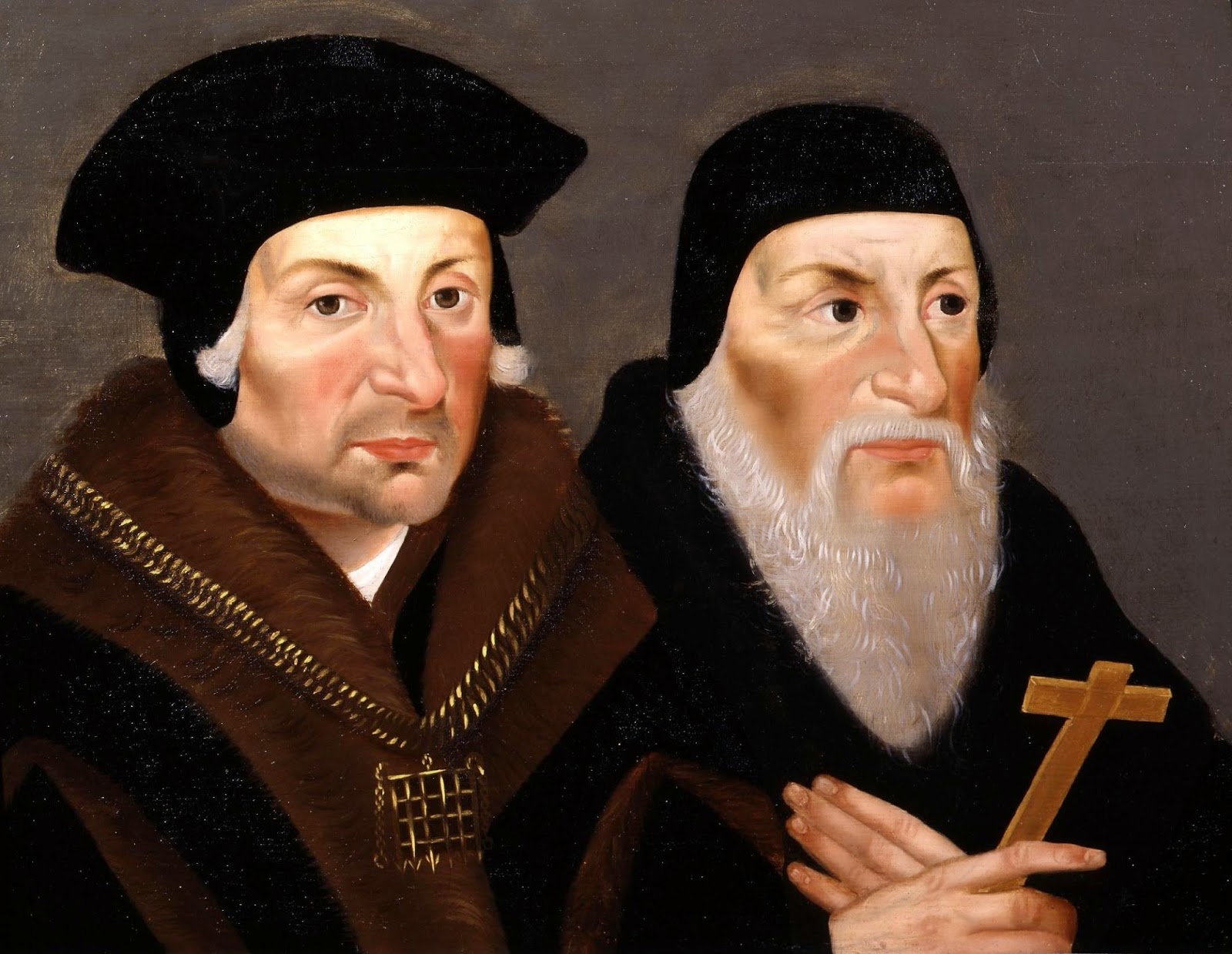
For the traditional Latin Mass propers for this day, please see the post at this link.
Unfortunately, when I first published this post I confused the Votive Mass for St. Thomas More with the feast day Mass. As of July 3, 2015, I have corrected this. For the Votive Mass for St. Thomas More, please see another of my 2015 posts at this link.
Image: Historical portrait of Sts. Thomas More & John Fisher. English school. From Wikimedia Commons. In the public domain.
Sunday, July 6, 2025
Christian Heroes - SS. John Fisher & Thomas More - July 9 Feast

Here is the text from the pre-1955 St. Andrew Missal,
introducing the July 9 Feast Day Mass of SS. John Fisher & Thomas More:
Among the Christian heroes who fought resolutely against heresy and laid down their lives rather than adhere to the schism in England, a place of honor is due to Cardinal John Fisher and to the Chancellor Thomas More.Source of Text: Dom Gaspar Levebre, O.S.B., The Saint Andrew Daily Missal, republished by St. Bonaventure Publications (1999), p. 1846 (St. Bonaventure Internet site: www.libers.com)
John Fisher, born at Beverley in 1469, chancellor of the academy of Cambridge, later for 33 years bishop of Rochester, refuted in many books the protestant errors (Brev.)
Thomas More, born in London in 1478, a layman, married and the father of a family, learned jurist and scholar, was made High Chancellor of England by Henry VIII.
Both were imprisoned in the Tower of London by order of the king because they were opposed to his illegitimate union with Anna Boleyn and because they refused him the usurpated title of supreme head of the Church of England in matters spiritual as well as temporal.
John Fisher, created cardinal by Pope Paul III, ascended the scaffold on the 22th of June 1535 and was beheaded after reading this sentence of the Gospel: "This is eternal life that they may know Thee, the only true God, and Jesus Christ, whom Thou has sent." (All.)
Thomas More was beheaded in his turn on the 6th July 1535 for having resisted, after the example of the great doctor of the law Eleazar (Ep.) all solicitations on the part of his own family and which he deemed contrary to his conscience and to the rights of God, of Christ and the Church (Gosp.)
Image: Commemorative plaque at Tower Hill, from Wikimedia Commons
Thursday, January 5, 2023
Twelth Night and Thomas More as Master of Revels (1510)

It is Twelfth Night (Epiphany eve). In 1510 Thomas More served as Lord of Misrule for that festival. It is well known that St. Thomas More was devoted to his family. Yet duty prevented him from spending the twelve days of Christmas 1510 with them.
John Guy tells the story this way, reminding the reader that at this time Margaret was only five years of age and More's first wife, Joanna, was still alive:
"Money was no longer a problem; the children had their presents and their father had never seemed happier. And yet, instead of enjoying dinner with his family and playing with his children over the Twelve Days of Christmas, his chair stood empty. And he was nowhere to be seen when the London 'waits' [bands of musicians] called, as they did at the houses of all civic dignitaries, singing carols and entertaining the household, playing their oboes and cornets and taking down the serpent [a wind instrument] from its hook on the wall, before drinking from a wassail cup filled with hot milk curdled with wine and spices. Instead, he was at Lincoln's Inn, where he'd been elected to preside over the Christmas and New Year revels, playing the fool as 'Lord of Misrule' (or king of hoaxing) and making merry. He was an obvious choice for . . . he had a natural, laughing, bantering, rapier wit . . . He would have been in his element in his Inn of Court, where the Christmas revels marked the climax of the lawyers' social calendar, except that it was an honour that kept him away from home."

According to Peter Ackroyd, however, "A 'master of the revels' . . .
was not some figure out of Rabelais but an official in charge of [Lincoln
Inn's] most elaborate and prestigious annual ceremonies". And, "a lord of misrule supervised the
festivities of Christmas, which included masques and plays [.]"
Thus, it seems likely that it was St. T.M.'s organizational ability at least as much as his sense of humor that resulted in his election to this post.
Sources:
John Guy, A Daughter's Love (Houghton Mifflin Harcourt, 2009) and Peter Ackroyd, The Life of Thomas More (Anchor Books, 1999), Kindle editions without pagination
Friday, August 5, 2022

Friday, July 16, 2021
St. John Fisher, Bishop and Martyr
"When Henry tried to annul his marriage to Catherine of Aragon, Fisher became the Queen's chief supporter. As such, he appeared on the Queen's behalf in the legates' court, where he startled the audience by the directness of his language and by declaring that, like St. John the Baptist, he was ready to die on behalf of the indissolubility of marriage."

From the Wikipedia entry, which cites primary sources.
According to some sources, Bishop Fisher was also Catherine's confessor.
Image: John Fisher by Gerard Valck after van der Weirff (1697)
Thursday, July 8, 2021
Judge Robert Bork on St. Thomas More

From Judge Robert Bork - Thomas More for Our Season:
"The continuing contemporary interest in Thomas More (1478-1535) is hardly to be accounted for by popular fascination with sixteenth-century English politics or even by admiration for a martyr to a religious cause no longer universally popular.
"More lived, as we live today, in a time of rapid social and cultural unraveling. The meaning of his life, at least for us, is not so much his worldly success and religious piety, extraordinary as both of these were, but rather the courage and consistency with which he opposed the force of disintegration.
"The culture war of the early sixteenth century was fought over the breaking apart of Christianity, its loss of central authority, and the consequent fragmentation of European civilization. Our war rages about the collapse of traditional virtues across all of the West and the rise of moral indifference and cheerful nihilism. Many parallels between the two eras could be drawn, but a crucial similarity lies in the central role played by law in each. Though More was a profoundly religious man, it should not be forgotten that he was also a preeminent lawyer and judge. The law, quite as much as Catholicism, is crucial to an understanding of the man and the martyr. Law and its institutions were, of course, major forces of cohesion in More’s age, and are perhaps the primary symbols in ours of stability and continuity as well as justice. When moral consensus fades, as it did in More’s time and does in ours, we turn to law; when law falters, as it must when morality is no longer widely shared, society and culture teeter on the brink of chaos.
. . .
"An Elizabethan play, probably written by Shakespeare, has More attempt to quell rioters against aliens in London:
Grant them removed, and grant that this your noise
Hath chid down all the majesty of England.
Imagine . . .
Authority quite silenced by your brawl. . . .
What had you got? I’ll tell you. You had taught
How insolence and strong hand should prevail,
How order should be quelled; and by this pattern
Not one of you should live an aged man;
For other ruffians, as their fancies wrought
With self same hand, self reasons and self right
Would shark on you; and men like ravenous fishes
Would feed on one another."
Friday, March 19, 2021

Monday, January 11, 2021


Monday, July 13, 2015
Thomas Aquinas on Human Law and Natural Law

Our Saint, Thomas More, was no doubt familiar with the following from St. Thomas Aquinas:
"Human law is law inasmuch as it is in conformity with right reason and thus derives from the eternal law. But when a law is contrary to reason, it is called an unjust law; but in this case it ceases to be a law and becomes instead an act of violence.” (Summa theologiae, I-II, q. 93, a. 3, ad 2)
“Every law made by man can be called a law insofar as it derives from the natural law. But if it is somehow opposed to the natural law, then it is not really a law but rather a corruption of the law.” (Summa theologiae, I-II, q. 95, a. 2)
Thursday, July 9, 2015
Bolt's Rendition of More's Post-Conviction Speech
Here, in honor of the traditional feast day for St. Thomas More (July 9) is Robert Bolt's rendition -- in A Man for All Seasons -- of the Saint's post-conviction speech:
"Norfolk (leaping to his feet; all rise save More) Prisoner at the bar, you have been found guilty of High Treason. The sentence of the Court --
"More My lord!
Norfolk breaks off. More has a sly smile. From this point to end of play his manner is of one who has fulfilled all his obligations and will now consult no interests but his own.
My lord, when I was practicing the law, the manner was to ask the prisoner before pronouncing sentence, if he had anything to say.
Norfolk (flummoxed) Have you anything to say?
More Yes. (He rises: all others sit.) To avoid this I have taken every path my winding wits would find. Now that the court has determined to condemn me, God knoweth how, I will discharge my mind . . . concerning my indictment and the King's title.. The indictment is grounded in an Act of Parliament which is directly repugnant to the Law of God. The King in Parliament cannot bestow the Supremacy of the Church because it is a Spiritual Supremacy! And more to this the immunity of the Church is promised both in Magna Carta and the King's own Coronation Oath!
Cromwell Now we plainly see that you are malicious!
More Not so, Mr. Secretary! (He pauses, and launches, very quietly, ruminatively, into his final stock-taking.) I am the King's true subject, and pray for him and all the realm . . . I do none harm, I say none harm, I think none harm. And if this be not enough to keep a man alive, in good faith I long not to live. . . . I have, since I came into prison, been several times in such a case that I thought to die within the hour, and I thank Our Lord I was never sorry for it, but rather sorry when it passed. And therefore, my poor body is at the King's pleasure. Would God my death might do him some good. . . . (With a great flash of scorn and anger.) Neverthelsss, it is not for the Supremacy that you have sought my blood -- but because I would not bend to the marriage.!"
Source of text: A Man for All Seasons, copyright Robert Bolt 1960, unpaginated Kindle edition, published in 1995 by Bloomsbury Methuen Drama (www.bloomsbury.com). Fair use claimed for posting this short excerpt.
Friday, July 3, 2015
Votive Mass of St. Thomas More

POST UPDATED 6-26-2016 (added Latin without accent marks)
Here are the Collect, Secret, and Post Communion for the Votive Mass of Thomas More from the pre-1955 St. Andrew Daily Missal (pp. 1846-1847):
Collect:
Deus, qui beato Thomae Martyri inter saeculi illecebras et carceris mortisque dolores hilari fortique animo crucem tuam amplecti tribuisti: concede, quaesemus, ejus intercessione et exemplo, ut pro fide et justitia alacriter decertantes, ad aeterna gaudia laeti pervenire mereamur. Per Dominun.
O God, who didst grant unto the blessed Martyr Thomas, to embrace the cross with a cheerful and resolute spirit amid the allurements of the world and the pains of prison and death: grant we beseech Thee, by his intercession and example, that, quick to strive for faith and justice, we may deserve to come happily to the joys of eternal life. Through our Lord.
Secret:
Hoc sacrificium redemptionia nostrae, quaesumus, omnipotens Deus, clementer respice; et, intercedente beato Thoma martyre tuo, pro hac familia tua placatus assume. Per Dominum.
Do Thou, we beseech Three, almighty God, mercifully regard this sacrifice of our redemption; and appeased by the intercession of blessed Thomas, Thy martyr, receive it on behalf of Thy servants. Through our Lord.
Postcommunion:
Sint tibi, omnipotens Deus, grata nostrae servitutis obsequia: ut haec sancta quae sumpsimus, intercedente beato Thoma martyre tuo, nobis ad capessenda perpetis vitae praemia proficere sentiamus. Per Dominum.
Let the homage of our service be pleasing unto Thee, O almighty God, that, by the intercession of blessed Thomas, Thy martyr, the sacrament which we have received may profit us unto obtaining the rewards of eternal life. Through our Lord."
Saturday, February 7, 2015
Thomas More's Birthday

Today is the 537th anniversary of the birth of St. Thomas More. Our saint was born to lawyer Sir John More and his wife Agnes Graunger More on February 7, 1478 in the early hours of a Saturday morning. The plaque above marks the site of the family's Milk Street London home where the birth took place.
Friday, January 23, 2015
More Returns the Great Seal to Henry
 |
| Great Seal of England (reverse, ca. 1509 - Possibly that of Henry VII rather than Henry VIII) |
 |
| Old Palace of Whitehall (site of former York Place) by Hendrik Danckerts (ca. 1675) |
"At three o'clock of a spring afternoon in 1532, Thursday 16 May, Sir Thomas More was admitted to York Place 'beside the village of Westminster', as the official report of the ceremony puts it. It had been Wolsey's home but it now belonged to the king. He was taken to the garden, where the king awaited him. In the presence of the Duke of Norfolk, More then ceremoniously handed Henry VIII the pouch which contained the Great Seal of England. The king graciously received this symbol of office, and granted More leave to bestow the rest of his life in preparing his soul 'in the service of God'. 'And for the service which you before have done me,' Henry went on to say, 'you will find me a good and gracious lord unto you in any suit which should concern your honour or pertain unto your profit'."
 |
| Wolsey surrenders the Great Seal to Norfolk and Suffolk |
More bowed and withdrew. This was the last time More and Henry met in person. The seal, which had been returned by Wolsey before it was given to More, would soon be passed on to More's successor Audley.
Text: Peter Ackroyd, The Life of Thomas More (Anchor Books, New York, 1999) unpaginated Kindle edition.
Wednesday, January 21, 2015
Margaret's Prayer

When St. Thomas More was imprisoned in the Tower of London, his eldest daughter Margaret composed a special prayer for her and her father to pray in union with one another -- he in his cell and she at home:
"O Lord, give us grace of your tender pity so firmly to rest our love in you with little regard of this world, and so to flee sin and embrace virtue, that we may say with St. Paul, 'To me, to live is Christ and to die is wealth', and again 'I wish to be discharged and to be with Christ'. Send me, O Lord, the grace, wretch that I am far, far, farthest of all other from such point of perfection, to amend my life, and continually to have an eye to mine end, without grudge of death, which to them that die in God is the gate of a wealthy life which God of his infinite mercy bring us all, Amen."Source: John Guy, A Daughter's Love, (Houghton Mifflin Harcourt, New York, 2009), p. 249;
Last Letters of Thomas More, Alvaro de Silva, Ed. (William B. Eerdmans, Grand Rapids, Michigan, 2000), pp. 104-107 (Letter 17).
Saturday, January 17, 2015
Thomas More and the Anthonie Pigs

The St. Anthony Hospitallers went about with bells soliciting alms. Pigs given into their care wore bells and were the only hogs permitted to run loose in London. These Tantony pigs (Tantony being a contraction of St. Anthony) often followed persons carrying greens and persisted until they were given some to eat. Thus the term "Tantony pig" came to be applied to persons easily led about.
According to Peter Ackroyd's biography of St. Thomas More:
"The pupils of More's school were known as 'Anthonie pigs', because the figure of that saint was customarily accompanied by one of those animals; the pig was once a symbol of the devil, but it had now been domesticated and St. Anthony himself was the patron saint of hogs as well as butchers. Little is known about London pigs in the 15th century except that they were smaller than the present variety, but the connection between them and the hospital brothers of St. Anthony's was well established. Those pigs which were too unhealthy or unwholesome to be fit for market were taken from the Stocks and were slit in the ear as a sign of their inedibility; it was customary for the proctor of St. Anthony's to tie a bell around the necks of such animals before letting them roam among the refuse and dunghills of the London streets. . . . they were fed by hand, much as Londoners would feed the kites and ravens; they were, like the birds, consumers of noisome waste. And so the proverb was soon current, 'Such an one will follow such an one, and whine as it were an Anthony pig', which duly became attached to the schoolboys themselves. . . . If the pigs grew fat and healthy on their London diet, they were taken up by the authorities of St. Anthony's in order to be cooked and eaten."For further reading about the Tantony pigs, visit The History Girls.
Text: Peter Ackroyd, The Life of Thomas More (Anchor Books, 1999), unpaginated Kindle edition.
Image: St. Anthony Abbot by Piero di Cosimo, ca. 1480. From Wikimedia Commons. In the public domain.

Tuesday, January 13, 2015
More's Family Devotions

It is well known that St. Thomas More and his family made devotions together that included the Seven Penitential Psalms and the Litany of the Saints.
Peter Ackroyd writes:
"[More's] entire household joined him when he returned home to his devotions; he led them in morning and evening prayers, which included the penitential psalms and the litanies of the saints. During their meals one of the family would read a passage from the Scriptures, which would then become the subject of general conversation."Reading devotional material during meals is a monastic practice such that one can see how More integrated his monastic experience into his family life.
Text: Peter Ackroyd, The Life of St. Thomas More (Anchor Books, 1999), Kindle edition without pagination.
Image: "Man of Sorrows Petitioned by Penitents", from the Penitential Psalms of the Hours of Catherine of Cleves, Illuminated by the Master of Catherine of Cleves, Utretcht, The Netherlands, ca. 1440, tempera on vellum. The Morgan Library & Museum (New York).
Sunday, December 28, 2014
Thomas More and Thomas Becket

December 29 is the feast day of St. Thomas Becket. The saint was born in 1118 or 1120 in Cheapside, London. The day was December 21, the Feast of St. Thomas the Apostle. Becket served as Lord Chancellor of England from 1155-1162 and as Archbishop of Canterbury from 1162-1170. On December 29, 1170, Becket was murdered in Canterbury Cathedral by henchmen of Henry II, as a result of differences between the king and Becket regarding church-state relations.
In his biography of Thomas More, who was martyred under Henry VIII, Peter Ackroyd explains that Thomas More's maternal grandfather was named Thomas (which was likely the proximate explanation for More's baptismal name) but that Thomas Becket was "still the great saint of the city, the martyr and subsequent worker of miracles." Thus, More was likely named after Becket as well.
Ackroyd notes that the More family home on Milk Street just twenty yards from where Becket was born. On his way to school every day, young More would pass Becket's birthplace at Ironmonger Lane and Cheapside where by then there was a church dedicated to Becket.
Much later, "More felt a strong attachment to his saintly namesake, now that his own life in opposition to the king so closely resembled that of the murdered archbishop."
In a letter shortly before his death, More told his daughter Margaret that "he wished to die on that following day, Tuesday, because of its coincidence with the vigil of the translation of the relics of St. Thomas Becket." More's reference was to July 7, 1220 (the 50th jubilee year of Becket's death) when, with great ceremony, Becket's relics were transferred from their grave to a shrine in Trinity Chapel in the east end of Canterbury Cathedral. Thus, began a major feast on July 7 commemorating that event.
Thomas More was indeed beheaded on July 6, 1535, the eve of the feast of the translation of Becket's relics. And the following year (1536), the July 7 feast in honor of Becket was suppressed. Relics of both saints are now in the rebuilt Walsingham shrine (which was destroyed during the dissolution of the monasteries, and its image of Our Lady burnt).
Text: All quotes in text are from Peter Ackroyd, The Life of St. Thomas More (Anchor Books, 1999), Kindle edition without pagination.
Image: Photograph by Immanuel Giel of a Thomas Becket plaque on the floor of Canterbury Cathedral. From Wikimedia Commons in the public domain.

Thursday, July 31, 2014
Norfolk

Image: Thomas Howard, Third Duke of Norfolk, by Hans Holbein the Younger. From Wikimedia Commons. In the public domain.

Tuesday, July 29, 2014
Lincoln's Inn

Image: From Wikimedia Commons. In the public domain.

Subscribe to:
Posts (Atom)